
If you're building a product-based business, at some point you'll ask the same question almost every importer asks: how to source products from China without losing money to a bad supplier, a missed deadline, or a customs surprise.
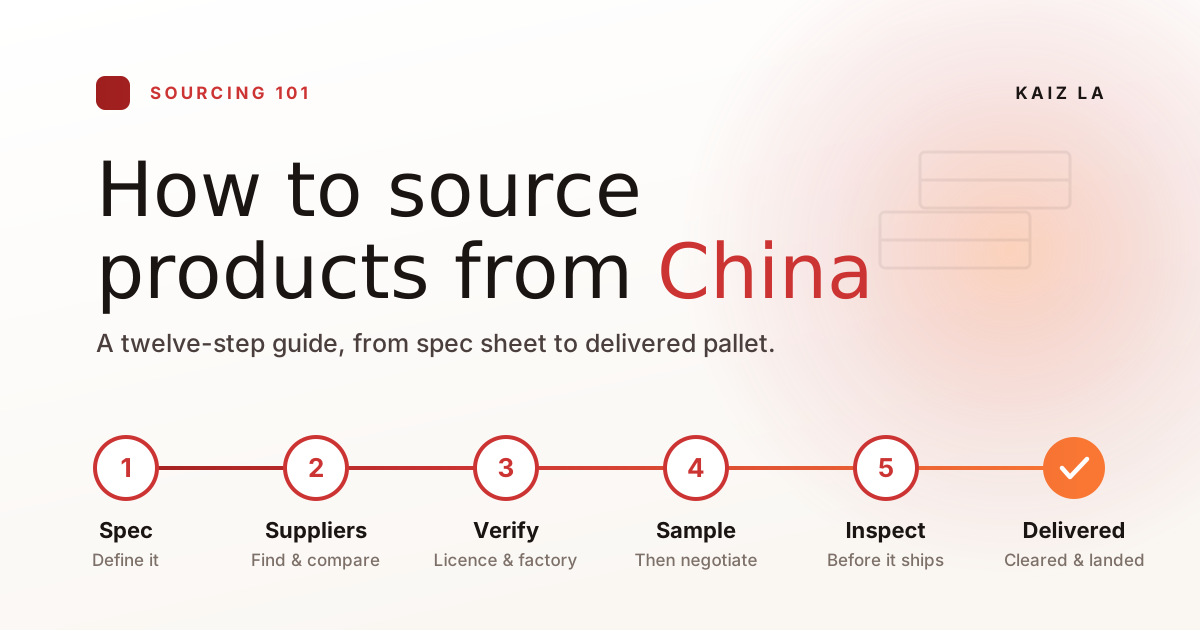
The short answer is that sourcing from China is a process, not a single transaction. You need to define your product clearly, find and compare several suppliers, verify that they're legitimate, test the product with samples, negotiate terms that protect you, inspect the goods before they ship, and plan for shipping and customs before the order is even placed. Skip a step, and it usually shows up later as a quality problem, a delayed shipment, or a cost you didn't budget for.
This guide walks through the full China sourcing process in order, compares where to actually find suppliers (Alibaba, 1688, Global Sources, the Canton Fair, and direct factories), explains how to verify a Chinese supplier, breaks down the real cost of sourcing beyond the unit price, and covers the mistakes that trip up most first-time importers. Whether you're deciding to source products from China directly or through a sourcing agent, you'll find a practical, step-by-step reference here.
How to source products from China step by step
Sourcing products from China is a sequence of decisions, each of which narrows your risk. Here's the process in the order most importers actually follow it.
1. Decide exactly what product you want to source
Before you contact a single supplier, write down:
- The exact product, including size, materials, and function
- Target retail or resale price, so you know what unit cost you need
- Any certifications your market requires (CE, FCC, RoHS, BIS, SASO, etc.)
- Packaging expectations (retail box, bulk carton, private label)
Common mistake: Reaching out to suppliers with a vague idea (“a wireless speaker, similar to X”) instead of a spec sheet. Vague briefs get vague quotes that aren't comparable to each other.
What to check before moving on: Can you describe your product in one paragraph that a factory could quote from without asking ten follow-up questions?
2. Research the Chinese market and manufacturing regions
Different regions of China specialise in different product categories — for example, Guangdong for electronics and hardware, Zhejiang for textiles and small commodities, and Fujian for footwear. Knowing roughly where your product is made helps you evaluate whether a supplier is a genuine manufacturer or a trading company reselling someone else's production.
3. Find potential suppliers
Use more than one channel. Alibaba and 1688 are good for casting a wide net; the Canton Fair and referrals are good for finding suppliers who don't rely on marketplace listings. This is covered in detail in the next section.
Practical advice: Contact at least 5–10 suppliers per product to get a realistic price and quality range before narrowing down.
4. Compare suppliers and quotations
Put every quote in one sheet with the same columns: unit price, MOQ, sample cost and lead time, payment terms, production lead time, and included certifications. Quotes that look cheaper often exclude packaging, testing, or certain accessories — read the fine print.
Common mistake: Comparing quotes on price alone. A supplier quoting 15% cheaper but with a 45-day longer lead time and no quality documentation isn't automatically the better deal.
5. Verify supplier legitimacy
Before sending money or specifications, confirm the supplier is a real, operating business. See the dedicated section below on verifying a supplier and auditing a factory — this step is where most sourcing problems are prevented or missed.
6. Request samples
Never skip samples, even for simple products. A sample tells you:
- Whether the material and construction match what was described
- How the product performs under basic use or stress
- Whether the factory can actually produce to your spec, not just talk about it
Common mistake: Ordering bulk production straight after seeing a photo. Photos don't tell you about weight, feel, or functional issues.
7. Negotiate MOQ, pricing, payment terms, and specifications
Minimum order quantity (MOQ), price, and payment terms are all negotiable to some degree, especially once you're a repeat or higher-volume buyer. Get everything — spec, quantity, price, packaging, inspection rights, and payment schedule — into a written purchase agreement or proforma invoice before paying anything.
What to check: Does the agreement specify what happens if the goods fail inspection or don't match the approved sample?
8. Place the order
Standard practice is a deposit (commonly 30%) before production and the balance before or against shipping documents. Paying 100% upfront to an unverified supplier is one of the most common ways buyers lose money in China sourcing.
9. Conduct quality inspection
Arrange an inspection before the goods leave the factory — not after they land in your country, when it's too late to fix anything cheaply. This is covered in more detail further down.
10. Arrange shipping and logistics
Decide between sea freight (cheaper, slower) and air freight (faster, more expensive) based on your timeline and margins. For smaller orders, freight forwarders can consolidate your goods with other shipments (LCL) to reduce cost. For a closer look at cost and timeline trade-offs, see sea vs air freight from China.
11. Handle customs and import requirements
Every destination country has its own duty rates, documentation requirements, and restricted or regulated product categories. Confirm the correct HS code, required certificates, and applicable duties for your product before it ships, not after it arrives at the port. In the United States, for example, U.S. Customs and Border Protection publishes official guidance for new importers on entry requirements, documentation, and duty payment. If you're importing into India or the Middle East specifically, see duties, customs, and logistics for India and the Middle East for region-specific requirements.
12. Receive and evaluate the shipment
Check the delivered goods against your inspection report and purchase agreement. Keep records of every discrepancy — they matter if you need to raise a claim with the supplier or a payment-protection service.
Where to find products and suppliers in China
There's no single “best” way to source products from China — each channel suits a different stage of sourcing.
Alibaba
Alibaba is the largest B2B marketplace connecting global buyers with Chinese suppliers and is usually the first stop for new importers.
- Pros: Huge supplier base, built-in messaging, supplier ratings, and Trade Assurance, a payment-protection service that holds funds in escrow until you confirm the order matches the agreed terms.
- Cons: Many “suppliers” are trading companies, not factories; badges and reviews can be gamed; product listings don't always reflect actual production capability.
- Best for: First-time importers researching product categories, price ranges, and initial supplier lists. For a closer look at avoiding common scams on the platform, see how to buy from Alibaba safely.
1688
1688.com is Alibaba's domestic Chinese marketplace, generally used by buyers with a China-based team, agent, or partner, since it's in Mandarin and largely built around domestic payment and shipping.
- Pros: Often lower prices than Alibaba, since sellers aren't pricing in export marketing costs; access to smaller factories that don't sell internationally.
- Cons: Language barrier, no built-in export logistics or English-language buyer protection, harder to verify suppliers without local knowledge.
- Best for: Buyers working with a sourcing agent or partner already based in China.
Global Sources
A B2B platform similar to Alibaba but with a stronger focus on verified manufacturers, especially in electronics and hardware, and closely tied to its own trade shows in Hong Kong.
- Pros: Generally more manufacturer-heavy listings than trading companies.
- Cons: Smaller supplier pool than Alibaba overall.
- Best for: Electronics, gadgets, and hardware sourcing where supplier credibility matters more than price comparison volume.
Canton Fair
Officially the China Import and Export Fair, held twice a year in Guangzhou and co-hosted by China's Ministry of Commerce and the Guangdong provincial government, the Canton Fair is one of the largest sourcing events in the world, bringing tens of thousands of exhibitors together under one roof.
- Pros: Meet suppliers face to face, see and touch physical samples, compare multiple factories in the same category in one trip.
- Cons: Requires travel and time; not practical for very small or exploratory orders.
- Best for: Buyers ready to place meaningful order volumes and who want direct factory relationships.
Direct manufacturers
Sourcing directly from a factory (rather than through a marketplace listing or trading company) usually gets you better pricing and more control over production, but requires you to do your own supplier discovery, vetting, and quality management — or have someone on the ground doing it for you.
- Pros: No middleman markup, direct communication with the people actually making your product.
- Cons: Harder to find without local knowledge; factories are less used to handling small, first-time export orders.
- Best for: Established importers with consistent volume, or those working through a sourcing agent who already has direct factory relationships.
China sourcing agents
A sourcing agent or sourcing-as-a-service partner sits between you and the supplier, handling supplier discovery, negotiation, quality checks, and sometimes logistics, on your behalf. See what a China sourcing agent does and how to choose one for more detail, and the comparison section below for a fuller breakdown.
| Channel | Best for | Watch out for |
|---|---|---|
| Alibaba | First-time research, broad supplier comparison | Trading companies posing as factories |
| 1688 | Lower prices via a China-based partner | Language barrier, no buyer protection |
| Global Sources | Electronics/hardware, manufacturer-heavy listings | Smaller overall supplier pool |
| Canton Fair | Face-to-face vetting at volume | Requires travel and lead time |
| Direct manufacturers | Repeat, higher-volume buyers | Hard to find and vet without local presence |
| Sourcing agent | Buyers who want the process managed end to end | Adds a service fee |
How to verify a Chinese supplier before placing an order
No single check guarantees a supplier is legitimate — verification is about stacking several independent signals so that no one red flag slips through.
- Company information. Ask for the supplier's registered business name and check it against their invoices, contracts, and bank details. Names that don't match across documents are a warning sign.
- Business licence. Legitimate Chinese suppliers can provide a business licence number. This confirms the company is registered, though it doesn't confirm production capability or financial stability on its own.
- Factory verification. Ask for a factory address and, where possible, photos or a video call from the production floor. Some suppliers listed as “manufacturers” are actually trading companies subcontracting production — this isn't automatically a problem, but you should know which one you're dealing with.
- Product samples. A sample tests the supplier's actual output, not just their claims. See the sampling step above.
- Relevant certifications. For regulated categories (electronics, toys, cosmetics, food-contact items), ask for the specific certificates your destination market requires and verify they match your exact product, not a similar one.
- References or transaction history. Ask for buyer references where possible, and treat marketplace ratings and reviews as one data point, not proof, since these can be inflated.
- Communication quality. Slow, evasive, or inconsistent answers to specific technical questions are often a better predictor of problems than any document.
- Payment terms. Suppliers who insist on 100% payment upfront, refuse standard deposit structures, or push you toward untraceable payment methods warrant extra caution.
- Third-party inspection. An independent quality inspection before shipment is one of the most reliable ways to confirm what you're actually getting, regardless of how the supplier presented itself beforehand.
How to calculate the real cost of sourcing products from China
The quoted unit price is only one line in your total landed cost. Underestimating everything else is one of the most common reasons first-time importers end up with thinner margins than they planned for.
Costs to account for:
- Product cost — the per-unit price at your agreed MOQ
- MOQ — a low unit price at a very high minimum order quantity can tie up more capital than a slightly higher price at a workable MOQ (see how to negotiate lower MOQs if you're testing a product before committing to volume)
- Sample cost — usually higher per unit than bulk pricing, plus courier shipping
- Packaging — retail packaging, labelling, and private-label branding are often quoted separately from the base unit
- Domestic China transportation — moving goods from the factory to the port or consolidation warehouse
- Inspection — third-party quality inspection fees, typically charged per inspection day
- Freight — sea or air, plus insurance
- Customs duties, taxes, and tariffs — vary by product classification (HS code) and destination country
- Agent or service fees — if you're using a sourcing agent, this is usually a percentage of order value or a flat service fee
- Other charges — bank transfer fees, currency conversion spreads, warehousing if goods sit before final delivery
Simplified example: A product quoted at $4.00/unit with a 1,000-unit MOQ might land closer to $5.20–$5.60/unit once you add packaging, inspection, freight, and duties — a 30–40% increase over the quoted price. This is illustrative only; your actual landed cost depends on your product, weight, volume, and destination country's duty rates.
Common mistakes to avoid when sourcing from China
- Choosing the cheapest supplier immediately, without comparing quality, lead time, or communication
- Ordering large quantities without samples, based only on photos or descriptions
- Not confirming product specifications in writing before production starts
- Ignoring MOQ mismatches, agreeing to a quantity that doesn't fit your cash flow or storage capacity
- Paying in full upfront to a supplier you haven't verified
- Skipping quality inspection to save on cost or time, especially on a first order
- Not calculating landed cost, and being surprised by duties, freight, or inspection fees after the fact
- Poor communication of requirements, assuming the supplier will infer details you never actually specified
- Choosing a supplier based only on marketplace ratings or badges, rather than direct verification
Should you source directly or use a China sourcing agent?
Both approaches can work — the right one depends on your volume, experience, and how much time you can dedicate to managing the process yourself.
| Factor | Direct sourcing | Sourcing agent |
|---|---|---|
| Cost | No agent fee, but higher risk of hidden costs from mistakes | Service fee added, but often offset by negotiated pricing and fewer costly errors |
| Supplier discovery | You do the research and outreach | Agent uses an existing vetted network |
| Negotiation | You negotiate directly, with less leverage as a smaller or first-time buyer | Agent often has stronger factory relationships and volume leverage |
| Quality control | You arrange inspections yourself, or skip them | Usually built into the service |
| Communication | Language and time-zone gaps managed by you | Agent bridges language and cultural gaps |
| Logistics coordination | You coordinate freight forwarders, customs brokers, and last-mile delivery separately | Often consolidated under one point of contact |
| Risk | Higher, especially for first-time importers | Lower, but not eliminated — vet your agent too |
| Best suited for | Experienced importers with existing China relationships and time to manage details | First-time importers, or businesses that want to focus on sales and growth rather than logistics |
Direct sourcing makes sense once you have volume, a track record with specific factories, and the internal capacity to manage quality control and logistics yourself. A sourcing agent or sourcing-as-a-service partner makes more sense when you'd rather have one accountable team handle supplier vetting, negotiation, quality checks, and freight, instead of coordinating several vendors — agents, inspectors, and freight forwarders — who often don't communicate with each other.
How Kaiz La helps businesses source products from China
Kaiz La is a sourcing-as-a-service company headquartered in Hong Kong, working on the ground in China to connect businesses across India, the Middle East, and Southeast Asia with vetted Chinese factories.
Kaiz La's core services cover the sourcing process end to end:
- Supplier discovery and negotiation — sourcing and vetting factories, then negotiating price, MOQ, and payment terms on the buyer's behalf
- Quality control and production tracking — pre-production sample sign-off, in-line and pre-shipment inspections, and production updates during manufacturing
- Warehousing and consolidation — short-term storage and consolidating multiple supplier orders into a single shipment
- Customs clearance and compliance — HS-code classification, duty estimates, and documentation for import into India, the GCC, and Southeast Asia
- International freight — sea (FCL and LCL) and air freight options
- Last-mile delivery — door-to-door delivery coordination to the buyer's warehouse, store, or site
Kaiz La also offers additional services including private label and OEM support, sampling and prototyping, factory audits, and marketplace/FBA preparation.
The idea behind running these stages under one team, rather than splitting them across a marketplace, a separate inspector, and an independent freight forwarder, is that there's a single point of accountability if something goes wrong at any stage of the order.
Need help sourcing products from China? Talk to Kaiz La about your sourcing requirements.
Conclusion
Successfully sourcing products from China isn't about finding the supplier with the lowest unit price — it's about managing a full process where supplier reliability, product quality, clear communication, total landed cost, and logistics all carry roughly equal weight. Skip any one of them, and it tends to resurface later as a delay, a quality dispute, or a cost you didn't plan for.
Whether you handle each step yourself or work with a sourcing partner, the fundamentals stay the same: define your product clearly, verify suppliers before you pay them, test with samples, inspect before shipping, and calculate your real landed cost before you commit to volume.
If you'd rather have an experienced team manage supplier discovery, quality control, and logistics on your behalf, talk to Kaiz La about your sourcing requirements.
Frequently asked questions
Is China good for product sourcing?
China remains one of the largest manufacturing bases in the world across nearly every product category, from electronics to textiles to industrial machinery, which is why it's a common starting point for importers. That said, “good” depends on execution — the same manufacturing scale that makes China attractive also means quality and supplier reliability vary widely, so verification and inspection matter regardless of category.
What is the best website to source products from China?
There isn't a single best website — it depends on your stage. Alibaba is generally the best starting point for research and initial supplier comparison. 1688 often has lower prices but is better suited to buyers with a China-based partner. Global Sources tends to skew toward manufacturers in electronics and hardware.
How do I find manufacturers in China?
Use a combination of B2B marketplaces (Alibaba, 1688, Global Sources), trade shows like the Canton Fair, industry-specific directories, and referrals from other importers in your category. Confirm whether a listed “manufacturer” is an actual factory or a trading company reselling someone else's production.
Is Alibaba safe for sourcing products?
Alibaba itself is a legitimate, widely used platform, and its Trade Assurance service provides payment protection on eligible orders. Safety still depends on which supplier you choose and how carefully you verify them — Trade Assurance protects against issues like non-shipment or products that don't match agreed order terms, but it isn't a substitute for supplier vetting or quality inspection.
How much money do I need to start importing from China?
This varies enormously by product and MOQ. Beyond the unit cost multiplied by your MOQ, budget for samples, packaging, inspection, freight, and customs duties, all of which can add a meaningful percentage on top of the quoted unit price — see the cost breakdown above.
What is MOQ?
MOQ stands for minimum order quantity — the smallest quantity a supplier will produce or sell per order. MOQs vary by supplier and product complexity and are often negotiable, especially for repeat buyers or when combining several product variants into one order.
How can I avoid scams when sourcing from China?
Verify the supplier's business registration and factory before paying anything, insist on samples before bulk production, avoid paying 100% upfront to an unverified supplier, use platform payment protection where available, and arrange independent quality inspection before shipment.
Do I need a sourcing agent in China?
Not necessarily — many experienced importers source directly. A sourcing agent tends to be worth the fee for first-time importers, buyers without existing China relationships, or anyone who'd rather have one team manage supplier vetting, quality control, and logistics instead of coordinating multiple vendors themselves.
How long does sourcing and shipping from China take?
Timelines vary by product and order size, but as a rough shape: supplier research and sampling can take a few weeks, production typically runs several weeks depending on complexity and order volume, and shipping adds roughly 20–40 days by sea or a few days by air, before customs clearance at destination.
Services for this
Quality Control & Product Inspection in China
Independent AQL inspections on the factory floor, before your goods ship.
Customs Clearance & Import Compliance
Classification, duty estimates and documentation handled on both sides of the border.
International Freight from China — Sea & Air
Sea and air freight at negotiated rates, routed around your deadline and your margin.